
Rethinking Curriculum – The importance of the expressive arts and how they can support the whole curriculum
🌟Unlock the Power of the Arts in Education!🌟 Join us for an insightful session hosted by Rethinking Curriculum, where we champion the importance of high-quality expressive arts across the curriculum. Discover how creative arts can break down the barriers of outcomes-driven curriculum design. Hear from an expert panel as they explore why engaging with the […]
Institute of AI Education: Inaugural Research Symposium 2
We are delighted to invite you to the inaugural Research Symposium of the Institute of AI Education (AIE), in partnership with York St John University. This is a free, online event bringing together teachers, school leaders, lecturers and researchers to share and celebrate meaningful work in AI education. This event is symposium 2 and will […]
Institute of AI Education: Inaugural Research Symposium 1
We are delighted to invite you to the inaugural Research Symposium of the Institute of AI Education (AIE), in partnership with York St John University. This is a free, online event bringing together teachers, school leaders, lecturers and researchers to share and celebrate meaningful work in AI education. This event is symposium 1. Theme: Understanding AI […]
Rethinking Curriculum – How to include your pupils in curriculum choices
As curriculum expectations evolve, it’s easy to overlook the key stakeholders in curriculum reform—the young people! Our work with Rethinking Curriculum highlights the significance of creating opportunities for student agency and voice when designing your school’s curriculum. In this session, practitioners and researchers will discuss why this is crucial and how you can implement it […]
Rethinking Curriculum – How can we ensure a curriculum nurtures wellbeing and belonging?
We know that wellbeing and belonging directly impact young people’s outcomes and sense of worth within schools, yet it is often forgotten or an afterthought to whole school curriculum design. In this session, hear from experts across the education sector around why they believe that this work must be a starting point and how you […]
How to improve Early Childhood Education and Care for children under 3
How can countries expand early childhood education and care (ECEC) for children under age 3 while ensuring quality and equity? Drawing on insights from the latest TALIS Starting Strong survey, this webinar will look at how OECD countries are responding to challenges in the sector, including fragmented provision and persistent inequalities in accessing ECEC. Joined […]
Getting students back to school – and keeping them engaged
School attendance problems are rising across many education systems, raising important questions about why students are missing school and what can be done to help them stay in school and engaged in learning. A new OECD report, Every Day Counts: Understanding, Preventing and Responding to School Attendance Problems, challenges the idea that attendance is simply […]
The nature of order processing deficits in developmental dyscalculia: The influences of familiarity and the count-list

Children with developmental dyscalculia often show impaired performance on number order processing tasks. Recent findings suggest these deficits are not general in nature but rather specific to certain kinds of sequences. One proposal by Slipenkyj and colleagues (2025) is that dyscalculic children struggle specifically to understand that “in order” can refer to sequences outside of […]
New to Science Leadership Programme
Are you a Key Stage leader, subject leader or thinking of becoming a Head of Department? Join ASE this autumn, for our New to Science Leadership Programme. ASE are working in partnership with Astin Consulting to offer this fast paced, interactive, practical leadership programme designed for new or aspiring science leaders in secondary schools. Through an […]
Getting students back to school – and keeping them engaged

School attendance problems are rising across many education systems, raising important questions about why students are missing school and what can be done to help them stay in school and engaged in learning. A new OECD report, Every Day Counts: Understanding, Preventing and Responding to School Attendance Problems, challenges the idea that attendance is simply […]
Topsy Page – An Introduction to Oracy
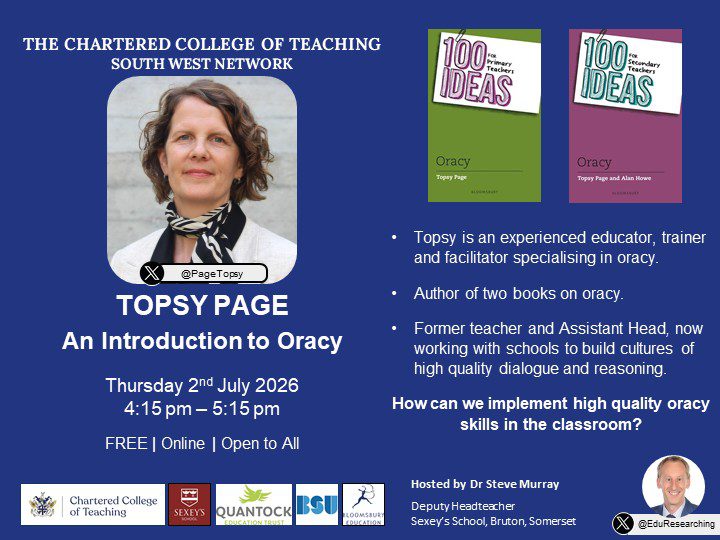
An introduction to the key principles of oracy and the vital role talk plays in learning. The session explores both how to develop oracy skills, and how to develop purposeful classroom dialogue to improve thinking, confidence and participation across the curriculum. Topsy Page is an experienced educator, trainer and facilitator specialising in oracy and Philosophy […]
Manageable workloads, personalised learning and enrichment: Insights from UNESCO’s Happy Schools Framework
This webinar comes to you as part of a series, partnered with UNESCO to explore their Why the World Needs Happy Schools report, placing a spotlight on each of the four pillars. In this session, we will discuss the Process pillar, examining how adapting our learning experiences, interactions and teaching approaches shape wellbeing, motivation and […]
Creativity Action Research Resource Launch
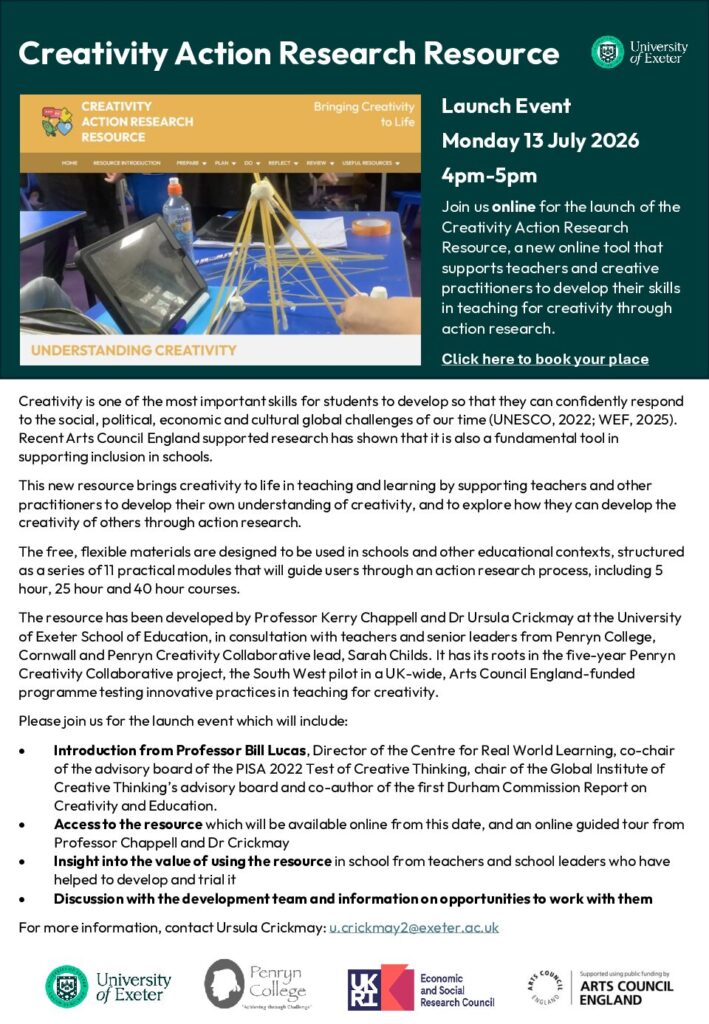
Join us online for the launch of the Creativity Action Research Resource, a new online tool that supports teachers and creative practitioners to develop their skills in teaching for creativity through action research. Click here to book your place Creativity is one of the most important skills for students to develop so that they can […]
The impact of handwriting and typing practice in children’s letter and word learning: Implications for literacy development
This talk presents empirical data on the benefits of handwriting—relative to typing—for literacy and spelling development and discusses why handwriting may positively influence reading development. Two studies are presented in which 50 pre-readers learned novel letters and words in an artificial orthography, either by handwriting or by typing. Linear mixed models revealed that children in […]
Teaching the British Empire: what is happening in schools and what can we learn?
Drawing on findings from the landmark Portrait EMB research project (https://dx.doi.org/10.5287/ora-rvno97kbq), this session explores what is currently happening in schools in relation to teaching about the British Empire, migration, and belonging, and what educators can learn from emerging practice across England. Based on one of the largest studies of its kind, involving over 1,000 teachers […]
From Curriculum to Classroom: Securing Strong Teaching for All Pupils
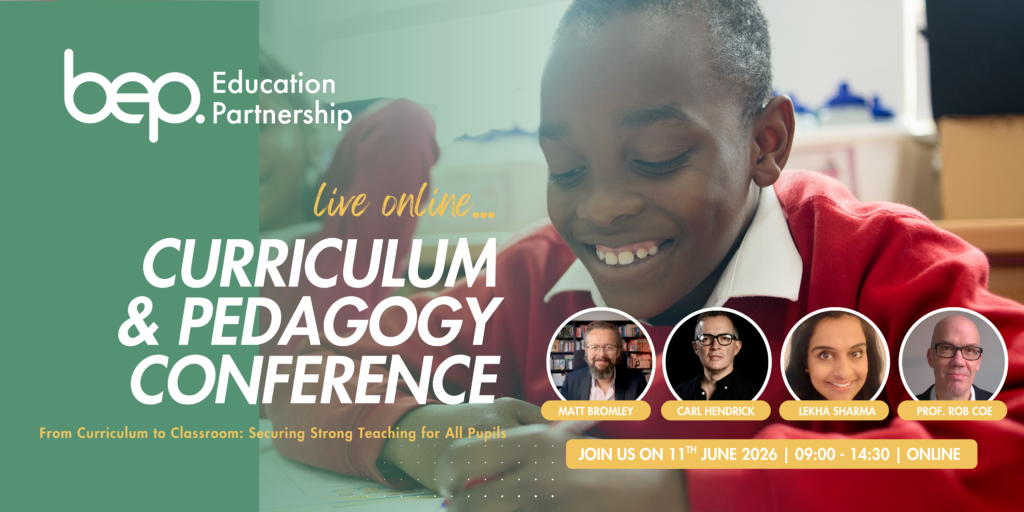
Schools are not short of ideas about curriculum. The challenge now is making those ideas work consistently in classrooms. This conference focuses on what strong teaching looks like in practice — how lessons are designed, how pupils experience the curriculum, and how leaders ensure that all pupils, particularly the disadvantaged, can access and succeed in […]
Unearthing Structures, Amplifying Voices: A Critical Realist Inquiry into the Lives of Autistic Teachers
In this webinar, Helen Bowhay, Director of Initial Teacher Education at the University of Nottingham, will introduce the key findings from her research into the lived experiences of autistic teachers in education. Despite increasing attention to diversity and inclusion for children and young people, there remains a significant lack of research that addresses these issues […]
Leading Professional Learning at Scale: Maximising CPD Spend

Teachers are happier and more likely to stay when they can access high quality CPD. Yet despite significant financial pressures, more can and should be done to ensure investment has impact – in England alone, a substantial share of the roughly £1 billion spent annually on CPD goes towards low-impact provision (TDT, 2025). Drawing on […]
Why does South Asian Heritage Month matter in schools?

Exploring why South Asian Heritage Month matters for schools across the workforce, pupils and wider school community South Asian Heritage Month (1 July – 31 July) is a national month of recognition, but what does it mean for schools? It is an opportunity to celebrate, reflect and connect. This one hour webinar brings together educators […]
Evidence Informed Wisdom
Wouldn’t it be great if research could simply tell us what to do? However, research can only inform our judgement, not replace it. In this webinar, Dr Claire Badger will look at how an understanding of research evidence combined with knowledge of your own context and your personal experience can help you make better decisions. […]